

Images
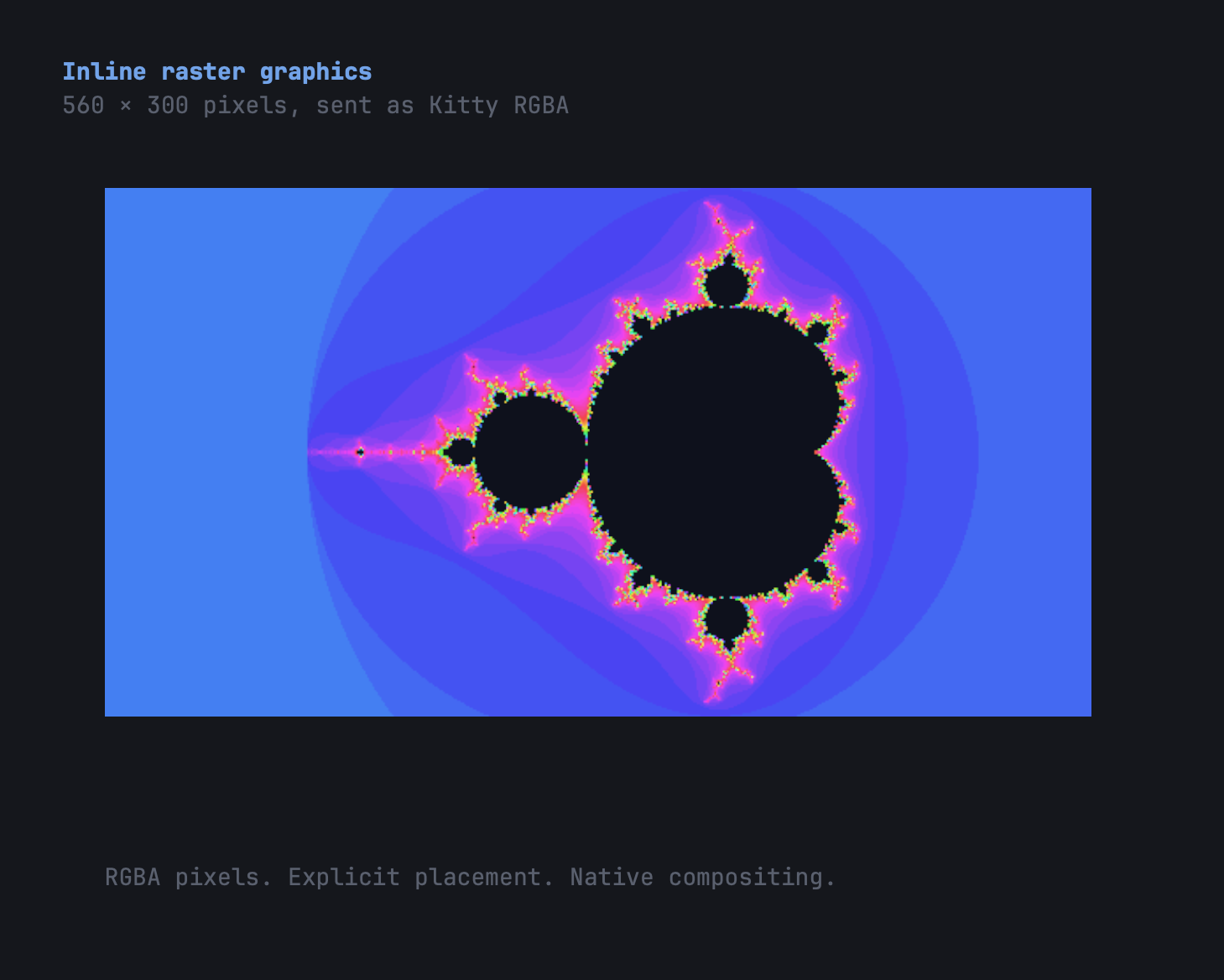
Programs can put pictures in the terminal with any of three protocols. Core decodes the image, places it in the grid and scrolls it with the text. Rendering and placement support differ by client.
Protocols
Section titled “Protocols”| Protocol | Sequence | What it carries |
|---|---|---|
| Kitty graphics protocol | APC G … ST |
PNG, raw RGB or RGBA, zlib-compressed payloads, sent in chunks. Placement by cells or pixels, z-index, deletion, animation frames, and Unicode placeholders that let an image live inside text a multiplexer can pass through. |
| Sixel | DCS q … ST |
Paletted bitmaps in six-row bands. |
| iTerm inline files | OSC 1337 ; File=… |
A base64 file with width, height and aspect options. |
PNG and zlib are decoded by Core’s own decoders, and TIFF as well; other formats go through the platform’s image decoder.
Where images appear
Section titled “Where images appear”The macOS and iPhone and iPad apps draw images on the GPU. The Linux frontend uploads them as Vulkan textures. The web client composites images and Tek graphics on its CPU path. Agent screenshots can composite inline images with the grid.
Graphical Emacs supports source crops, whole-cell offsets and RGBA transparency when PNG support is available. Without PNG it can display opaque RGB through PPM. Subcell offsets, overlapping placements, behind-text images and Unicode placeholders are not rendered equivalently. Text-mode Emacs and the Neovim client do not draw inline images. These limits also apply to hosted sessions; local protocol support is not a promise of animation or placement parity on every remote client.
Limits
Section titled “Limits”Image data is untrusted input, so each terminal holds at most 32 images, 128 placements and 256 MiB of decoded pixels, with 64 MiB and 16,384 pixels per side for any one image. At capacity, older images outside the live screen are evicted first, including images in scrollback; images on the live screen are kept when slots run out. A platform decoder allocates before the size check runs, so a single oversized file can briefly use more memory than the budget.
Filtering and fit
Section titled “Filtering and fit”Sampling is a renderer choice; use native size for exact pixel placement. A program that wants an image to fill the window can enter mode 7402 and choose contain, stretch, native size or an integer scale with OSC 7402.
Turning protocols off
Section titled “Turning protocols off”[security] dcs_deny = "sixel" refuses Sixel; osc_deny = "1337" refuses inline files. Rendering an image is not a permission the capability tiers gate: images draw for local, agent and remote sessions alike.
Ubiquitty and this site are copyright © 2026 Stanislav Yaglo. Ubiquitty is licensed under the Apache License 2.0.
Apple, iPad, iPadOS, iPhone, Keychain, Mac, macOS, Metal, Swift and Xcode are trademarks of Apple Inc., registered in the U.S. and other countries and regions.