

Rich text
A program can place a block of styled text into a rectangle of cells: a heading in one family and size, a paragraph in another, colour, bold, italic, underline and strikethrough. The body is a documented subset of the Rich Text Format, which the text systems of every desktop platform already produce.
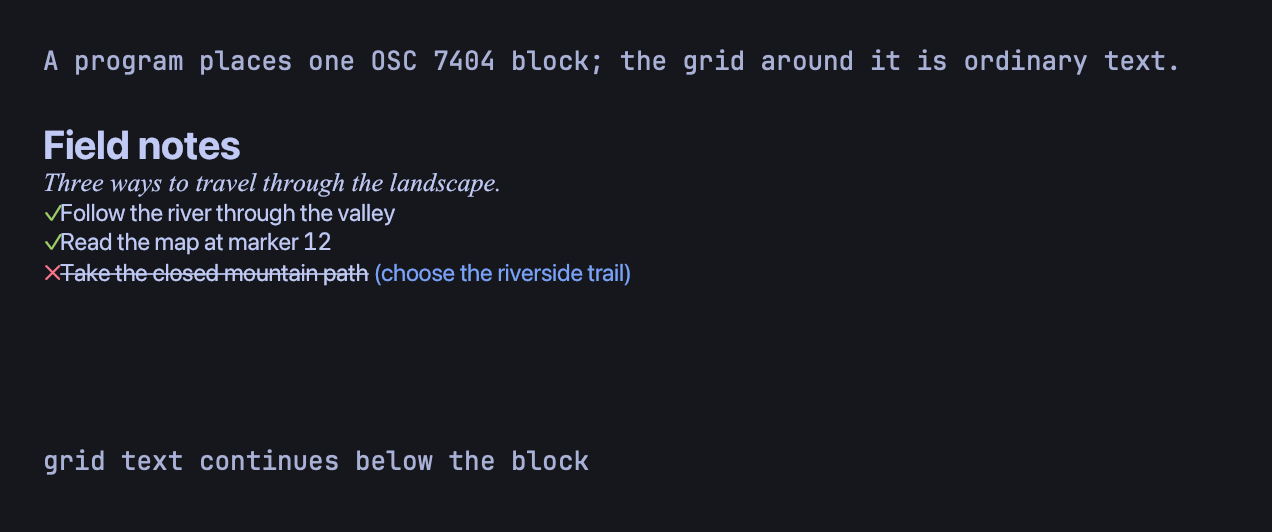
The sequence
Section titled “The sequence”OSC 7404 ; a=p : w=<cells> : h=<rows> [: i=<id>] [: o=w|c|e] [: j=l|c|r] ; {\rtf1 …} STa=pplaces a block at the cursor,wcells wide andhrows tall.a=qmeasures first: how many characters and lines a style gets in a rectangle, or whether a given body fits.a=ddeletes blocks.ochooses wrap, clip, or wrap with an ellipsis;jsets the default alignment.
A refused sequence changes nothing and answers nothing, exactly as a terminal without the feature would behave, and an empty query doubles as feature detection. Selection inside a block works per character, and copying yields the text. The full contract is the rich text specification.
Limits
Section titled “Limits”A block’s RTF body is capped at 16,384 bytes, with 4,096 characters and 512 style runs per block and 64 blocks per screen. Rendering limits:
- The Linux, web and software renderers do not draw blocks.
- Ligatures and kerning are off inside a block, and justified paragraphs are set flush left.
- Background colour, tables, lists, links and pictures in the RTF are ignored.
- A row with double width or double height refuses a block.
Measuring layout
Section titled “Measuring layout”Layouts and rasters are retained until the source, typography or placement changes, and rows are found by binary search for pointer hits and selections. Applications should cache fit-query results by source, width and typography revision, since a query may take one round trip to the client that owns the fonts. See Performance for measuring a workload.
Ubiquitty and this site are copyright © 2026 Stanislav Yaglo. Ubiquitty is licensed under the Apache License 2.0.
Apple, iPad, iPadOS, iPhone, Keychain, Mac, macOS, Metal, Swift and Xcode are trademarks of Apple Inc., registered in the U.S. and other countries and regions.