

Rendering and performance
Core decides what a frame contains: which rows changed, which glyphs they need, where images sit, what the cursor looks like. Each platform rasterises glyphs with its own text stack and draws the result on its own GPU interface. The work is split so that the model is locked only while a frame is captured, never while the GPU runs.
The renderers
Section titled “The renderers”| Platform | Drawing | Text |
|---|---|---|
| macOS | Metal, through one Swift renderer shared with iOS | CoreText |
| iPhone and iPad | The same Metal renderer | CoreText |
| Linux | Vulkan, with a CPU path | FreeType and HarfBuzz, fontconfig |
| Web | WebGL2, with a CPU 2D-canvas path | The browser’s fonts or the built-in bitmap face |
The web client’s GPU output is checked against its CPU raster, which serves as the reference for what a frame should contain.
What a frame does
Section titled “What a frame does”- Only changed rows are rebuilt. Each row carries a content digest; a frame rebuilds the rows whose digest moved.
- Synchronized output. A program that brackets an update with mode 2026 is drawn at the end of the bracket, never halfway through it.
- Paced by the display. On macOS a display link drives frames;
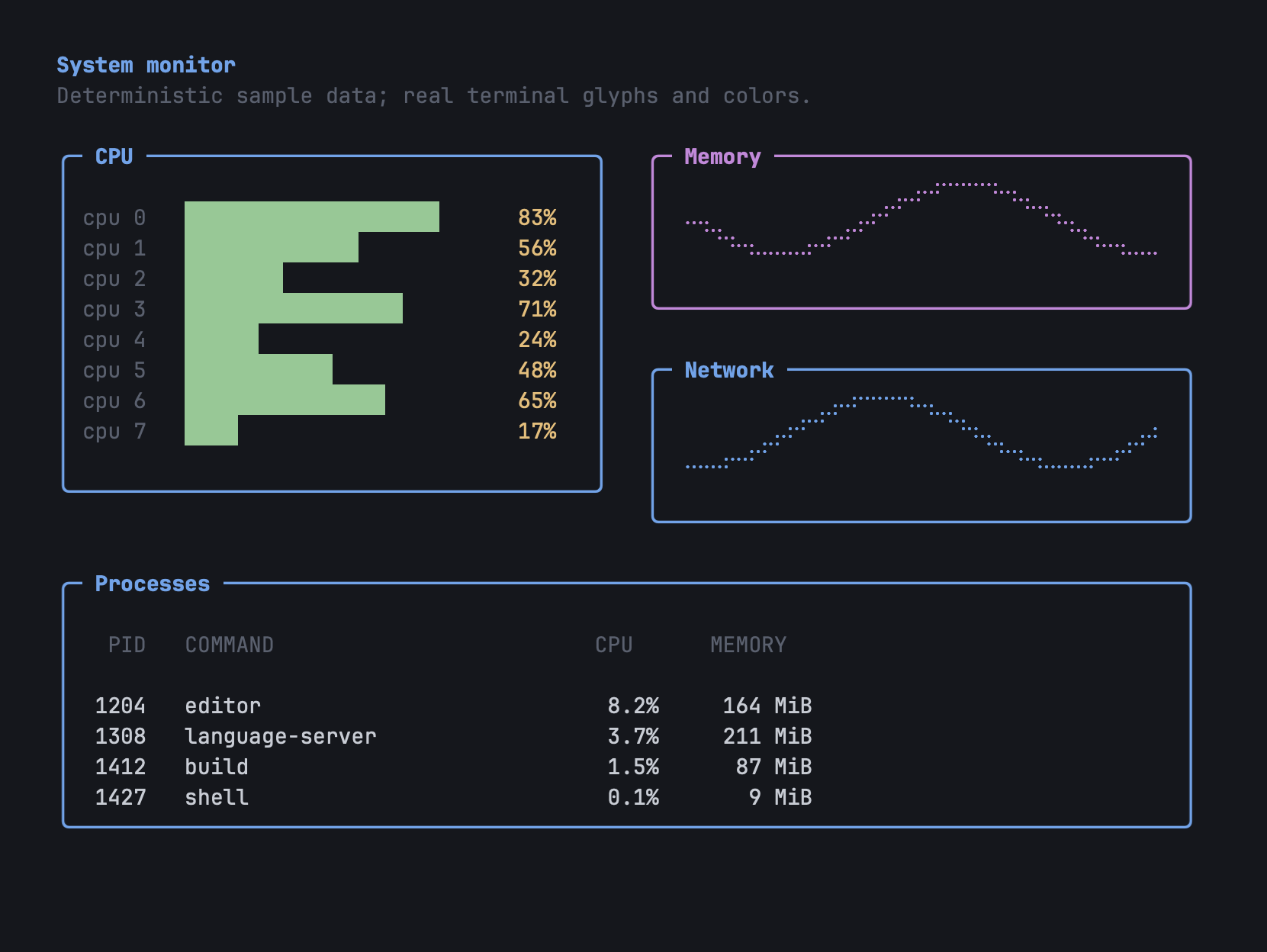
[render] max_fpscaps the rate and[render] vsyncchooses tear-free presentation. - Box drawing that tiles. Box-drawing characters come from the font, stretched to the cell edges so lines meet without seams. Blocks, shades, Legacy Computing symbols, octants and Powerline separators are drawn as geometry. Braille is drawn as a dot lattice in seven styles.
- Resizing. The macOS app draws whole rows during a resize drag and reflows content to the resulting grid.
- Colour. sRGB or Display P3 output on macOS. Translucent backgrounds, behind-window blur and a background image are available on macOS; blur works on Linux where the compositor supports it.
Measurement
Section titled “Measurement”The repository records parser, frame-building, search and storage measurements with their workload and build environment. Performance links the baselines and reproduction commands. Parser throughput, frame rate, and input-to-display latency are measured separately.
Ubiquitty and this site are copyright © 2026 Stanislav Yaglo. Ubiquitty is licensed under the Apache License 2.0.
Apple, iPad, iPadOS, iPhone, Keychain, Mac, macOS, Metal, Swift and Xcode are trademarks of Apple Inc., registered in the U.S. and other countries and regions.