

Neovim
The client is licensed under Apache-2.0 alone.
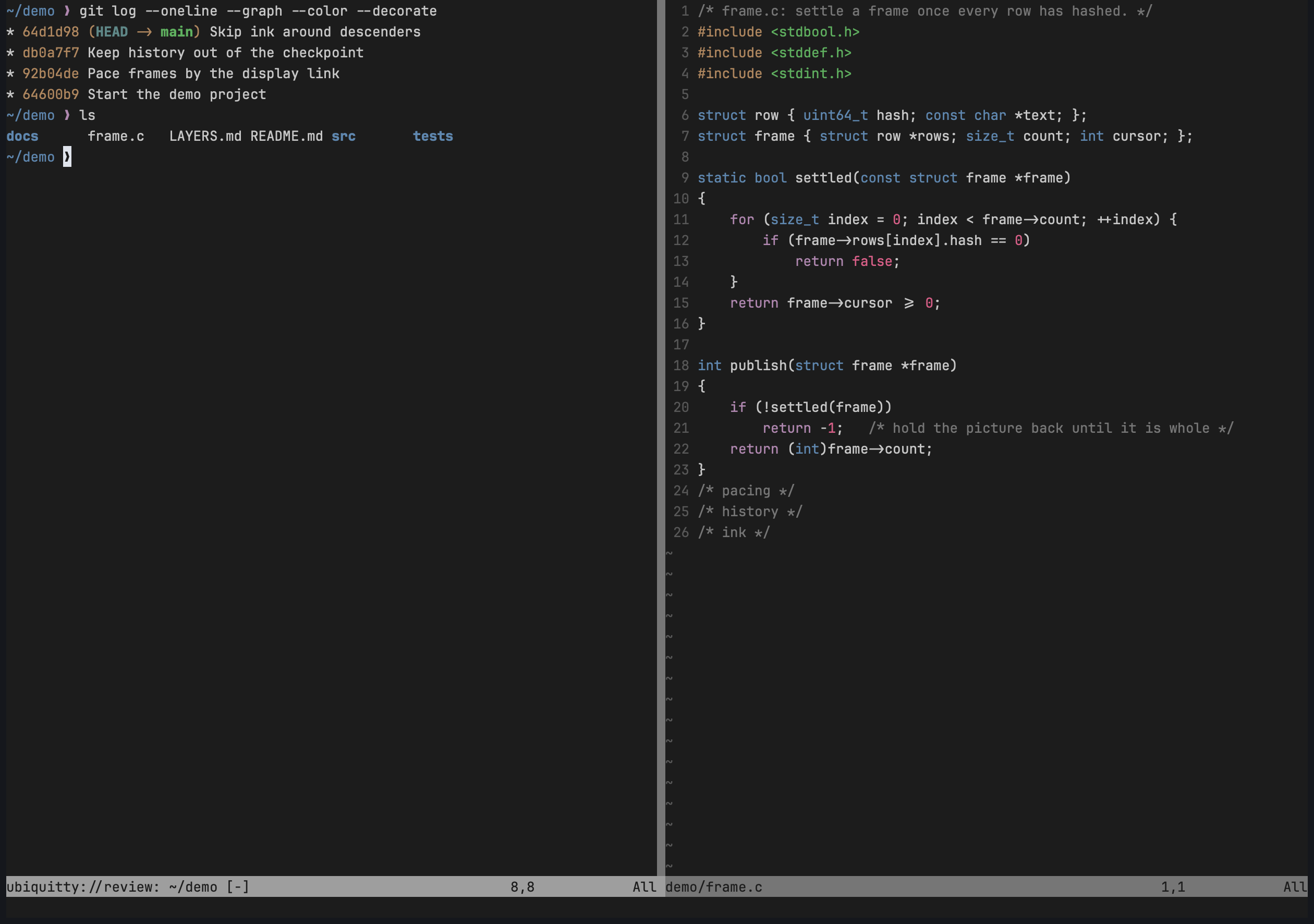
The Neovim plugin attaches to a session on ubiquitty-host and paints it into a terminal buffer. Keys typed in the buffer reach the session. The terminal runs in the host, so the session outlives Neovim and can be open in the macOS app at the same time.
What it does
Section titled “What it does”- Draws the screen from the host’s checkpoint and row updates.
- Mirrors the session’s cursor-key, keypad, bracketed-paste and mouse modes, and sends interrupts.
- Resizes the session with the window.
The client does not draw inline images or the host’s scrollback, and has no consent prompts or QUIC transport. It does not recompute the protocol’s checksums.
Install
Section titled “Install”Requirements: Neovim 0.10 or later, and the ubiquitty-host binary (in the macOS app at /Applications/Ubiquitty.app/Contents/Helpers/ubiquitty-host, or built with ./Scripts/build-host.sh).
With lazy.nvim:
{ dir = "/path/to/ubiquitty/Source/Platform/Neovim", name = "ubiquitty_sync", cmd = "UbiquittySync", opts = { -- Only needed when ubiquitty-host is not on PATH: host_program = "/Applications/Ubiquitty.app/Contents/Helpers/ubiquitty-host", }, config = function(_, opts) require("ubiquitty_sync").setup(opts) end,}Then :UbiquittySync. The plugin runs ubiquitty-host --ensure-daemon and attaches through ubiquitty-host --attach; it never opens the host’s socket itself.
Ubiquitty and this site are copyright © 2026 Stanislav Yaglo. Ubiquitty is licensed under the Apache License 2.0.
Apple, iPad, iPadOS, iPhone, Keychain, Mac, macOS, Metal, Swift and Xcode are trademarks of Apple Inc., registered in the U.S. and other countries and regions.